
When measles appears in the news, the conversation centers on prevention and containment — case counts, exposure notifications, vaccination status, and public health advisories. That discussion operates at the community level.
When illness enters a household, the focus changes. The question becomes practical: how to care for the child in front of you. Supportive care means close observation, maintaining comfort and hydration, and recognizing when medical evaluation is necessary.
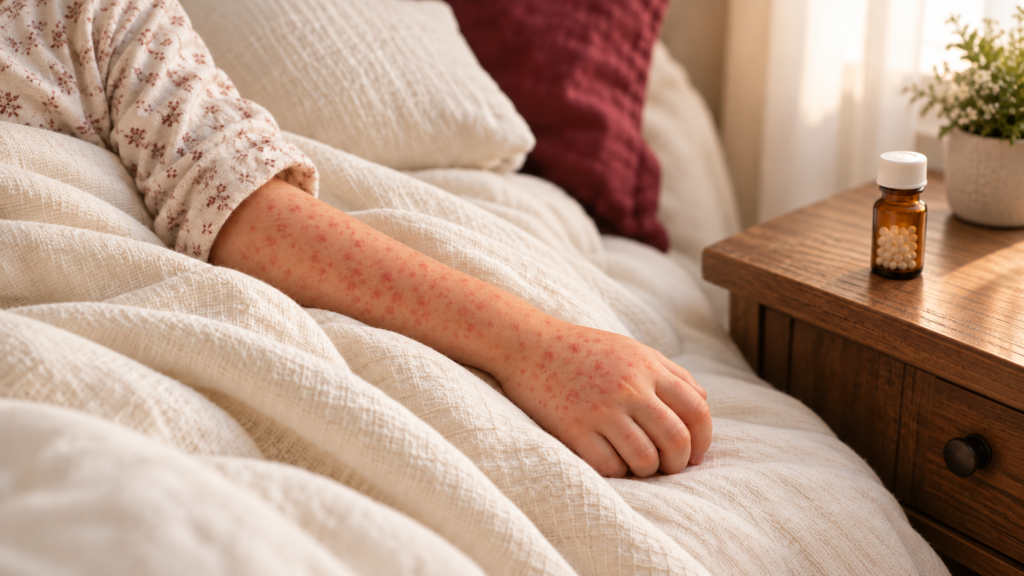
Measles typically begins with several days of fever and respiratory symptoms before the rash appears, usually starting at the hairline and moving downward over the body around the third to fifth day. In uncomplicated cases, the illness follows a recognizable course and resolves with supportive care. Complications can occur — including respiratory or, more rarely, neurological involvement — which is why attentive medical supervision remains essential.
In conventional medicine, measles is managed primarily through supportive monitoring unless complications arise. Homeopathy approaches acute illness through a different lens. Rather than centering treatment on the disease name, the focus is on how the illness is expressing itself in that individual child — the intensity of the fever, the quality of the cough, the child’s thirst, restlessness, sensitivity, and overall vitality. The remedy is selected according to the complete symptom picture.
Although certain remedies are traditionally associated with measles, there is no single “measles remedy.” Different children may require different prescriptions based on how the illness presents.
Supportive care is not confined to one medical system. Conventional monitoring and homeopathic treatment can proceed side by side. When caring for a sick child, having more than one approach available strengthens clinical care.